
Imagine this:
You’re standing in the middle of Silicon Mountain in Buea. To your left, a group of developers is building the next big Fintech app for the African market. To your right, a student is trying to download a 2MB PDF for a class assignment… and the progress bar hasn’t moved in ten minutes.
This is the reality of the Digital Divide in Cameroon.
On paper, Cameroon looks like a tech powerhouse in the making. We have multiple submarine cables landing on our shores. We have a booming startup scene. We even have 5G trials popping up in major hubs.
According to the latest data, 58.1% of Cameroonians still don’t use the internet.
Advertisement
That is more than half the population. In a world that is moving toward AI-driven economies and digital-first governance, being offline isn’t just an inconvenience.
It’s an economic death sentence.
The “Connectivity Paradox”
Why is it that in 2026, with all our natural resources and strategic location, the Digital Divide in Cameroon remains so wide?
If you ask the average person on the street in Douala or Yaoundé, they’ll tell you the same thing: “The connection is expensive, and when it works, it’s slow.”
But that’s only scratching the surface.
The truth is, the gap between the “Digital Haves” and the “Digital Have-Nots” isn’t just about who has a smartphone. It’s a complex cocktail of:
- Underutilized Infrastructure: We have the cables, but we aren’t using them.
- The Energy Tax: You can’t browse the web on a dead phone during a blackout.
- The Literacy Gap: Millions of people have access to a signal but don’t know how to turn that signal into a salary.
In this guide, I’m going to break down the cold, hard data behind these numbers.
I’ll show you exactly why 16 million people are still waiting to join the digital revolution—and more importantly—what it will take to finally close the Digital Divide in Cameroon for good.
Let’s dive in.
Chapter 1: The State of Connectivity in 2026
Numbers don’t lie. But in Cameroon, they tell a story of two different countries.
On one hand, you have the “Connected Elite” in Douala and Yaoundé who enjoy relatively stable 4G (and growing 5G) speeds. On the other, you have the vast majority of the nation where the internet is either a ghost or a luxury they simply can’t justify.
Advertisement
Let’s look at the “Connectivity Snapshot” for 2026:
- Total Population: ~29 Million
- Active Internet Users: ~12.1 Million
- The Offline Majority: ~16.9 Million (58.1%)
Here is the kicker: Mobile phone penetration is actually quite high—estimated at over 85%. This means millions of Cameroonians are walking around with a device in their pocket that could connect them to the world, yet they remain offline.
Why? Because having a phone is one thing; having a meaningful connection is another.
The Urban-Rural Paradox
The Digital Divide Cameroon is most visible when you leave the Centre or Littoral regions.
In Douala, internet penetration hovers around 65%. It’s the heartbeat of the digital economy. But as you move toward the Far North or the East regions, that number plummets to below 15%.
In these areas, the “internet” isn’t a browser or an app store. For many, the internet is synonymous with WhatsApp. If they can’t afford a “Social Media Bundle,” the internet effectively doesn’t exist.
Advertisement
The Submarine Cable Irony
This is the part that really stings.
Cameroon is actually blessed with infrastructure. We are connected to five major international submarine fiber optic cables:
- SAT-3 (South Atlantic 3)
- WACS (West Africa Cable System)
- NCSCS (Nigeria to Cameroon Submarine Cable System)
- SAIL (South Atlantic Inter Link)
- ACE (Africa Coast to Europe)
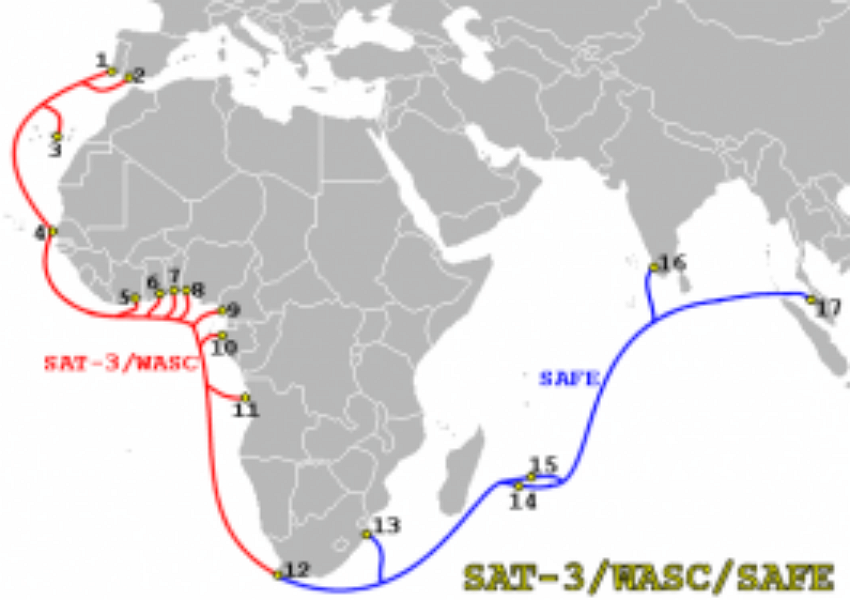
The Bottom Line: Cameroon has enough “bandwidth pipe” to provide high-speed internet to the entire CEMAC region.
The Reality: We are currently utilizing less than 16% of that total capacity.
It’s like having a 10-lane highway that leads into a dirt road. The “backbone” is there, but the “last mile”—the connection that actually reaches your house or your office—is broken. This structural bottleneck is a primary driver of the Digital Divide in Cameroon.
Until we fix the bridge between the ocean floor and the local neighborhood, the 58.1% will stay right where they are: in the dark.
But wait, it gets crazier.
Advertisement
It isn’t just about the cables. Even if we had fiber in every home, there is a “hidden tax” that most people forget to talk about. I’m talking about the cost of staying powered up.
In the next chapter, we’re going to look at the “Triple Threat” that is keeping Cameroonians offline.
Chapter 2: The “Triple Threat” (Why the Gap Persists)
So, we have the submarine cables. We have the people. We even have the mobile phones.
Yet, 58.1% of the country is effectively living in a “digital dark age.”
Why?
It boils down to three massive barriers that make up the Digital Divide in Cameroon. If we don’t solve these three things, the 16 million offline Cameroonians will stay offline forever.
1. The Affordability Barrier (The “2% Target” Failure)
The United Nations and the ITU have a clear goal: 2GB of mobile data should cost no more than 2% of the average monthly income (GNI per capita).
In Cameroon? We are nowhere near that.
Recent 2026 data shows that while prices have dropped slightly, mobile broadband still eats up roughly 3.4% to 5.3% of the average Cameroonian’s monthly income. For a civil servant in Yaoundé, that’s a nuisance. For a cocoa farmer in the South region, that’s the difference between buying data and buying a meal.
And it’s not just the data. It’s the Device Tax.
The average cost of a basic, “entry-level” smartphone in Sub-Saharan Africa is about 26% of monthly GDP per capita. In Cameroon, even a budget smartphone like a Tecno Pop or ZTE Blade will set you back roughly 50,000 to 70,000 FCFA.
The Reality Check: When a phone costs a month’s salary, the internet remains a “luxury good.”
2. Infrastructure & The “Energy Tax”
You can’t browse the web on a dead phone.
While Cameroon’s electricity access rate has climbed to approximately 73-75%, the quality of that power is the real bottleneck. Frequent load-shedding means that even if you have a 4G signal, the local tower might be running on a failing generator, or your phone might be off because you haven’t had power for 12 hours.
This creates a “Digital Reliability Gap.”
Tech companies in Douala literally have to pay an Energy Tax—spending millions on diesel generators just to keep their servers running. This cost is passed down to you, the consumer, making the Digital Divide Cameroon even wider.
3. The Digital Literacy Gap (Usage vs. Consumption)
Here is the most overlooked part of the problem: Digital Literacy.
Even if we gave every Cameroonian a free iPhone and free 5G tomorrow, we’d still have a divide. Why? Because thousands of students are still being taught “Computer Science” on a chalkboard.
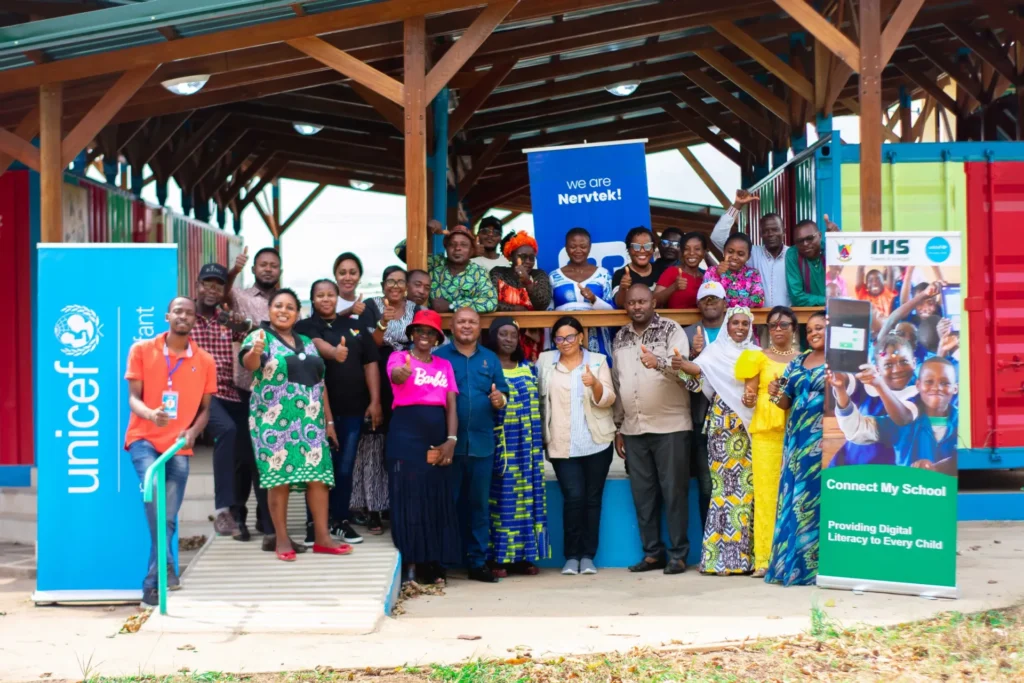
A recent UNICEF report highlighted that in many rural schools, digital learning exists only in theory. Teachers describe software they have never used. Students memorize the “parts of a computer” without ever touching a mouse.
The result? A generation that knows how to “consume” (scroll through TikTok or Facebook) but doesn’t know how to “create” (write code, manage a digital business, or use Google Workspace for remote work).
Closing the Digital Divide in Cameroon isn’t just about cables and towers; it’s about making sure the person holding the phone actually knows how to use it as a tool for progress.
But here is the million-dollar question:
What is this actually costing us? What happens to a country when over half its people are “invisible” to the global economy?
In the next section, we’re going to look at the Economic Impact—and the numbers are staggering.
Is Starlink the “Magic Bullet” for Cameroon’s rural internet? Or is it just another expensive toy for the elite?
Chapter 3: The Economic Impact (The Cost of Being Offline)
What happens when 58.1% of a country is “invisible” to the global economy?
It’s not just about missing out on TikTok trends. The Digital Divide in Cameroon is a massive weight dragging down our national GDP.
According to the World Bank, a 10% increase in mobile broadband penetration in developing countries can lead to a 1.2% to 2% increase in GDP growth.
In Cameroon, where the economy is projected to grow at around 3.5% in 2026, closing the digital gap could literally double our growth rate. Instead, we are leaving billions of FCFA on the table every single year.
The “Hidden” Economic Drain
When more than half the population is offline, the entire ecosystem suffers:
- E-Commerce Stagnation: You can’t build the “Amazon of Africa” if half your customers can’t access the website. This forces local businesses to rely on expensive, physical storefronts and “Cash on Delivery” models that are notoriously difficult to scale.
- The Brain Drain: Cameroon’s brightest tech talent isn’t staying to fight slow speeds. They are moving to Lagos, Nairobi, or Europe. Why? Because you can’t run a global SaaS company when your “High-Speed” fiber goes down twice a day.
- Agricultural Inefficiency: Imagine a cocoa farmer in the South Region who could increase his yield by 20% using real-time weather data and market pricing. Because of the Digital Divide in Cameroon, he is stuck using traditional methods, selling his crop for lower prices than he deserves.
Is Starlink the “Magic Bullet”?
As of April 2026, the buzz around Elon Musk’s Starlink in Cameroon has reached a fever pitch.
After years of regulatory hurdles and negotiations with the Minister of Posts and Telecommunications, Starlink is finally moving toward an official launch.
The Pros:
- Instant Infrastructure: It bypasses the need for 10,000km of fiber optic cables.
- Rural Reach: It can bring 100Mbps speeds to a village in the Far North as easily as it can to Douala.
The Cons (The Reality Check):
- The Price Tag: Even with “African pricing” (which we’ve seen drop to around $35-$50/month in other markets), it is still significantly higher than the average Cameroonian’s budget.
- The Hardware Hurdle: A Starlink kit still costs upwards of 200,000 FCFA. For the 58.1% of people currently offline, this is an impossible barrier.
The Bottom Line: Starlink will be a game-changer for businesses, NGOs, and the “Connected Elite.” But for the average Cameroonian, it won’t close the Digital Divide Cameroon unless the government or private sector subsidizes the hardware for schools and community hubs.
But wait, there is a silver lining. The government isn’t just sitting idle. From “Intelligent Classrooms” to new digital platforms, things are starting to move.
In the next section, we’ll look at the 2025-2026 Shifts that are actually starting to move the needle.
Is the “Digital Emergency” finally being treated like one? Let’s find out.
Chapter 4: 2025–2026 Shifts (Is the Tide Finally Turning?)
If you had written about the Digital Divide in Cameroon three years ago, the outlook would have been grim. But as we move through 2026, we are seeing the first real “cracks” in the wall of offline Cameroon.
The government and private sector have finally realized that “Digital Transformation” isn’t a buzzword—it’s a survival strategy.
Here are the three biggest shifts happening right now:
1. The Rise of “Intelligent Classrooms”
In March 2026, Cameroon took a massive leap in bridging the rural-urban education gap. Prime Minister Joseph Dion Ngute officially inaugurated the first “Intelligent Classroom” at Lycée Général Leclerc in Yaoundé.
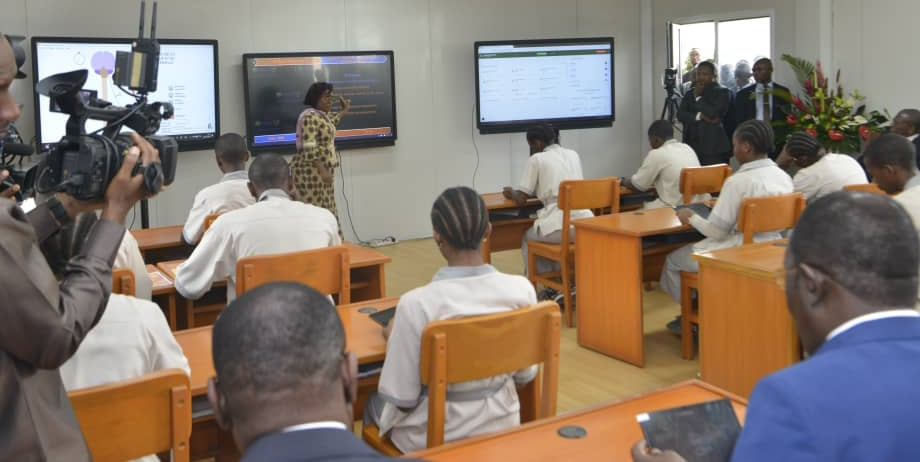
Why this is a game-changer:
These aren’t just rooms with computers. These units are built with solid steel, powered by 60 solar panels, and—here is the “237info” secret—they are designed to function without an internet connection or expensive electrical grids.
By using pre-loaded AI-driven educational tools, students in remote areas of the North West and East regions can now access the same high-quality digital lessons as a student in Paris or London. This is how you tackle the Digital Divide Cameroon at the root.
2. The NECAP Platform & PATNUC
For years, digital transactions in Cameroon were “siloed.” Moving money or data between different platforms was a nightmare.
Enter the National Electronic Communications Aggregation Platform (NECAP). Launched as part of the broader PATNUC (Cameroon Digital Transformation Acceleration Project), this platform is designed to:
- Standardize electronic signatures.
- Secure online contracts.
- Force interoperability between different digital service providers.
The result? It lowers the “Trust Barometer.” When people trust that their digital transactions are secure, they are more likely to spend money to get online.
3. The Digital Health Roadmap (2026-2030)
On March 4, 2026, the Ministry of Public Health unveiled the National Digital Health Strategic Plan. With a budget of over 29 Billion FCFA, the goal is simple: ensure that a patient in a remote village can get a specialist consultation via a tablet.
This initiative is critical because it gives people a reason to cross the Digital Divide in Cameroon. When the internet becomes the tool that saves your child’s life through telemedicine, it ceases to be a “luxury” and becomes a “necessity.”
The Bottom Line?
We are seeing a shift from “Connectivity for Entertainment” to “Connectivity for Utility.”
But even with these government wins, the real heart of Cameroon’s tech future isn’t in a ministry building in Yaoundé. It’s in the rainy streets of Buea and the coworking spaces of Douala.
In the next section, I’m going to show you a Case Study of how local heroes are fighting the Digital Divide Cameroon one line of code at a time.
Chapter 5: The “Silicon Mountain” Case Study (Thriving Against the Odds)
If you want to see how to beat the Digital Divide Cameroon, you don’t look at a government report.
You look at Buea.
Nestled at the foot of Mount Cameroon, this town—affectionately known as “Silicon Mountain”—is a living laboratory for digital resilience. While 58.1% of the country is offline, the developers in Buea are shipping code to clients in San Francisco and Berlin.
How? By using what I call “The Resilience Stack.”
The Blueprint for Beating the Gap
The tech community in Buea didn’t wait for the fiber optic monopoly to fix itself. They built a culture around three “hacks” that every Cameroonian business can learn from:
- Bandwidth Sharing (The Mesh Mindset): In hubs like Jongo Hub or ActivSpaces, entrepreneurs share high-cost, high-reliability connections. They pool resources to afford the “business-grade” fiber that is out of reach for individuals.
- Offline-First Development: Local developers are masters at building apps that work without a constant connection. They understand that a user in Kumba might only have 3G for two hours a day. By building apps that sync data only when a signal is present, they make the Digital Divide in Cameroon irrelevant to the user experience.
- Community-Led Literacy: Instead of waiting for school curriculum shifts, Silicon Mountain hosts “Code Camps” for kids. They are closing the literacy gap from the bottom up, creating a “Digital Pipeline” of talent.
The “Rural Hero” Factor
But it’s not just the cities. Look at NGOs like the Digital Bridge for Development Association.
They are setting up solar-powered “Digital Kiosks” in rural areas. These aren’t just internet cafes; they are community centers where farmers can check crop prices and students can access Wikipedia via local caches (offline servers).
The Lesson: You don’t always need a 100-mile cable to bridge the gap. Sometimes, you just need a solar panel and a local server.
Chapter 6: The Roadmap to 2030 (How We Fix This)
Closing the Digital Divide in Cameroon isn’t a mystery. We know what works. It’s about moving from “Pilot Projects” to “National Scale.”
Here is the 3-step plan to get that 58.1% down to 20% by 2030:
Step 1: End the Fiber Monopoly
Right now, the state-owned enterprise (Camtel) has a de facto monopoly on the fiber “backbone.”
The Fix: Open the backbone to private competition. When multiple companies compete to lay “Last Mile” cables, prices drop and quality skyrockets. Look at the “Nigeria model”—competition drives penetration.
Step 2: The “Zero-Rated” Education Initiative
The government should mandate that all local educational websites, government portals, and job boards be “Zero-Rated.” The Fix: This means a student can access their lessons even if they have zero balance on their SIM card. This removes the “Affordability Barrier” for the people who need it most.
Step 3: Incentivize Solar Tech for Telecoms
Telecommunication companies (MTN, Orange, Camtel) spend a fortune on diesel for their towers.
The Fix: Give tax breaks to telcos that switch to 100% solar-powered towers. This lowers their operating costs, which allows them to lower data prices for the consumer.
The Bottom Line: A Call to Action
The Digital Divide in Cameroon is the single greatest challenge—and the single greatest opportunity—facing our nation today.
Closing this gap isn’t just a “tech issue.” It’s a human rights issue. It’s an education issue. It’s a “putting food on the table” issue.
We have the cables. We have the talent. We even have the solar power. Now, we need the political and corporate will to connect the dots.
Here is my question for you:
Do you believe Starlink is the ultimate solution for rural Cameroon, or should we focus all our energy on fixing the local fiber network first?
Let me know your thoughts in the comments below.

