

These days, the sound of the modern Cameroonian economy isn’t the clink of coins or the rustle of paper money—it’s the distinct “ping” of a mobile money notification. Look around, and you’ll see it everywhere: those signature yellow and orange umbrellas marking the spot where “Call Box” agents are keeping the country’s money moving.
In 2026, mobile money is no longer just a “convenience” for the tech-savvy—it is the very heartbeat of the nation.
For decades, traditional banking remained a luxury for the urban elite, leaving millions of Cameroonians in the “informal” sector to rely on risky cash-under-the-mattress methods or traditional tontines. Today, that script has been flipped. From a grandmother in a remote village receiving a remittance from her son in Europe, to a corporate executive in Yaoundé paying their Eneo utility bill via a smartphone app, the digital wallet has become the great equalizer.
As Cameroon solidifies its position as the leader of the CEMAC (Central African Economic and Monetary Community) region—accounting for over 60% of all mobile money transactions in the zone—understanding how this ecosystem works is essential. Whether you are a local merchant, a member of the diaspora, or a visitor landing at Nsimalen International Airport, navigating the world of “Momo” and “OM” is your key to financial freedom in the Triangle.
In this guide, we’ll break down exactly how the system operates, the players dominating the market, the fees you should expect, and how to keep your digital “pocket bank” safe in an increasingly connected world.
The Key Players: Who Runs the Show in 2026?
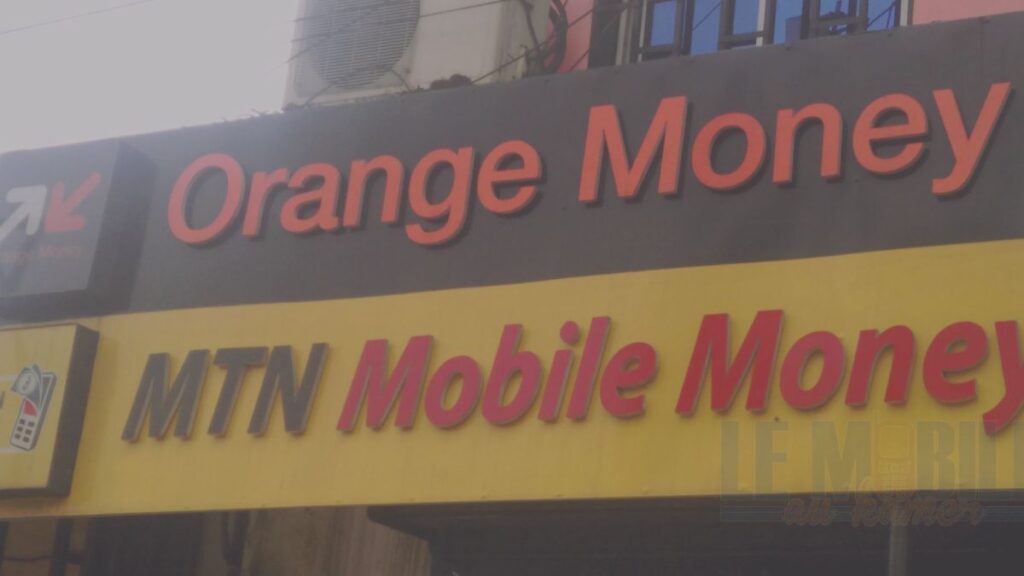
In 2026, the Cameroonian mobile money landscape is no longer a simple two-horse race. While the “Big Two” still command the majority of the market, new regulations and aggressive fintech competitors have forced a shift toward better service and lower fees.
Here are the key players running the show:
1. The Giants: Orange and MTN
For over a decade, these two have been the pillars of the digital economy, together controlling over 80% of all electronic transactions in the country.
- Orange Money (OM): As of early 2026, Orange Cameroon has solidified its lead in terms of revenue market share (roughly 50%). Its success is driven by the “Max it” super-app, which integrates everything from ticketing to micro-insurance. Orange is often perceived as the “lifestyle” choice, heavily integrated with high-end retail and international partners.
- MTN Mobile Money (MoMo): Historically the pioneer, MTN remains a powerhouse with a massive footprint in rural Cameroon. Despite a slight dip in revenue share compared to Orange, MoMo remains the king of volume for everyday peer-to-peer (P2P) transfers. Its focus in 2026 has been on MoMo Business, empowering thousands of SMEs with digital storefronts.
2. The Disruptor: Wave
The arrival of Wave (in partnership with Commercial Bank Cameroon – CBC) has been the biggest shock to the system.
- The “1% Model”: Wave’s entry into the Cameroonian market forced the giants to rethink their pricing. By offering free deposits and withdrawals and a flat 1% fee for transfers, Wave has become the go-to for cost-conscious users and students.
- Simplicity: Its “no USSD” approach (focusing on a clean, QR-code-driven app) has set a new standard for user experience in the country.
3. The Sovereign Entry: Blue Money (Camtel)
2026 marks the official rollout of Blue Money, the mobile financial service from the state-owned operator, Camtel.
- Strategic Advantage: Backed by an agreement with Ethio Telecom and controlling the national fiber-optic backbone, Camtel is positioning Blue Money as a “sovereign” alternative.
- Focus: It aims to capture the public sector—facilitating the payment of government salaries, pensions, and school fees—while leveraging its infrastructure to provide service in remote areas where private signals often flicker.
4. The Bridge: GIMACPAY
While not an operator you “join,” GIMAC is the most important player you don’t see. It is the regional switch that makes interoperability possible. In 2026, a “Yellow” user can finally send money to a “Red” user or a “Blue” user seamlessly. GIMACPAY connects:
- 53+ Banks (like Afriland, UBA, and SCB)
- 11+ Mobile Operators across the CEMAC zone
- Microfinance Institutions (MFIs): Allowing users to move money from their local credit union (Njangi/Tontine) directly to their mobile wallet.
Step-by-Step: How the System Works

In 2026, the mobile money system in Cameroon has reached a level of sophistication where you can manage your entire financial life from a basic “torch” phone or a high-end smartphone. Here is the breakdown of how the system functions, from the first “hello” to your final transaction.
1. Registration and KYC: Getting Started
To open a mobile money account, you don’t need a bank branch, but you do need legal identification.
- The SIM Card: You must have a registered SIM card from an operator (MTN, Orange, or Camtel).
- Identification (KYC): Visit any authorized kiosk or agency with your National ID Card (or Passport). The agent will scan your document and link your identity to your phone number.
- Activation: Once identified, you activate the service via USSD:
- MTN: Dial
*126#and follow the prompts to choose a 5-digit PIN. - Orange: Dial
#150#to access the menu and set up your secret code. - Camtel (Blue Money): Register at a Blue agency with your ID and dial
*825#to manage your wallet.
- MTN: Dial
2. Cash-In: Loading Your Wallet
Before you can spend, you need digital credit. This is known as a “Cash-In.”
- The Agent Network: Look for the “Call Box” operators or branded kiosks. You give them physical cash (XAF), and they transfer the equivalent digital value to your phone.
- Pro Tip: In 2026, Cash-In is free for the customer. If an agent tries to charge you a fee to deposit money, they are violating the operator’s rules.
3. Everyday Transactions: USSD vs. Super Apps
Cameroonians use two main “languages” to move money:
The USSD Method (Offline)
Perfect for basic phones or areas with poor internet.
- Orange Money:
#150# - MTN MoMo:
*126# - Camtel Blue:
*825#
The “Super App” Method (Online)
In 2026, apps like “Max it” (Orange) and the MoMo App offer a visual interface. These apps are often “zero-rated,” meaning you can use them even if you have 0 MB of data, provided your mobile data toggle is turned on.
4. Sending and Paying: The Core Functions
- P2P Transfers: Sending money to a friend. You enter their phone number, the amount, and your secret PIN.
- Merchant Payments: In 2026, QR codes are everywhere. You simply scan a code at a supermarket (like Carrefour or Casino) or a local pharmacy to pay instantly—usually for zero fees to the customer.
- Bill Payments: You can pay your ENEO (electricity), Camwater, or Canal+ subscription directly from the menu. The system generates a digital receipt instantly.
5. Cash-Out: Turning Digital into Paper
When you need physical cash, you visit an agent again for a “Cash-Out.”
- Initiate the withdrawal on your phone.
- The agent will ask for your phone number and the amount.
- You will receive a prompt on your screen to enter your PIN to authorize the withdrawal.
- The agent hands you the cash.Note: This is where transaction fees and the 0.2% government tax are typically deducted.
6. The 2026 Innovation: Bank-to-Wallet (Push/Pull)
One of the most powerful features today is the link between your mobile wallet and your bank account (UBA, Ecobank, Afriland, etc.).
- Pull: You can “pull” money from your bank account into your MoMo/OM wallet at 2:00 AM if you have an emergency.
- Push: You can “push” your daily earnings from your mobile wallet into your savings account for better security.
Interoperability: Breaking Down the Walls
In 2026, the biggest frustration of the early digital era—being “trapped” in one network—is finally becoming a thing of the past. The Cameroonian mobile money market has shifted from a series of isolated “walled gardens” to a connected web known as Interoperability.
Here is how the walls were broken down:
1. GIMACPAY: The Regional Connector
At the center of this revolution is GIMACPAY, the platform operated by the Interbank Electronic Banking Group of Central Africa (GIMAC). In 2026, GIMACPAY has moved beyond a pilot project to a massive clearinghouse that processed over 600 billion CFA in transactions last year alone.
- The “One Network” Experience: It allows a merchant using Orange Money to accept a payment from a customer using MTN MoMo or even a bank card from Gabon or Chad.
- Seamless Transfers: You can now send money directly from your MoMo wallet to an Orange Money user by selecting the “Interoperable” or “GIMAC” option in your menu.
2. Bank-to-Wallet (Push/Pull)
The wall between “traditional” banks and “mobile” wallets has crumbled. In 2026, almost every major bank in Cameroon (Afriland, UBA, Société Générale, Ecobank, etc.) is integrated with the mobile operators.
- The “Pull” (Bank to Wallet): If your bank account is linked to your phone, you can transfer money into your mobile wallet instantly via the bank’s app or USSD code.
- The “Push” (Wallet to Bank): Business owners often use this to “sweep” their daily mobile money earnings into their interest-bearing bank accounts at the end of the day, ensuring their funds are secure and professionalized.
3. The QR Code Standardization (CEMAC QR)
One of the most visible changes in 2026 is the GIMACPAY QR Code.
Previously, a shop counter would be cluttered with five different QR codes for different operators. Today, the government and BEAC (the regional central bank) have pushed for a unified QR standard.
- Scan-and-Go: You can scan a single QR code at a supermarket like Carrefour or Super U, and the system automatically identifies your provider (MTN, Orange, or Wave) and processes the payment without needing separate integrations.
4. Cross-Border Interoperability: The CEMAC Zone
Cameroon is no longer an island. Because of regional integration:
- Remittances: You can send money from your MoMo account in Yaoundé directly to a relative’s Airtel Money account in Libreville (Gabon) or a Moov account in N’Djamena (Chad).
- Travelers’ Ease: Cameroonian traders traveling to neighboring CEMAC countries no longer need to carry large amounts of physical cash; they can pay for goods or withdraw cash at local ATMs using their mobile wallets via the GIMAC network.
5. The Role of Fintech Aggregators
Companies like Flutterwave, Hub2, and ElyonPay act as the “glue” for the system. They provide a single API for websites and e-commerce platforms (like local delivery apps or online stores) to accept every payment method available in Cameroon—including the newcomer, Blue Money.
Costs, Fees, and the 2026 Tax Landscape
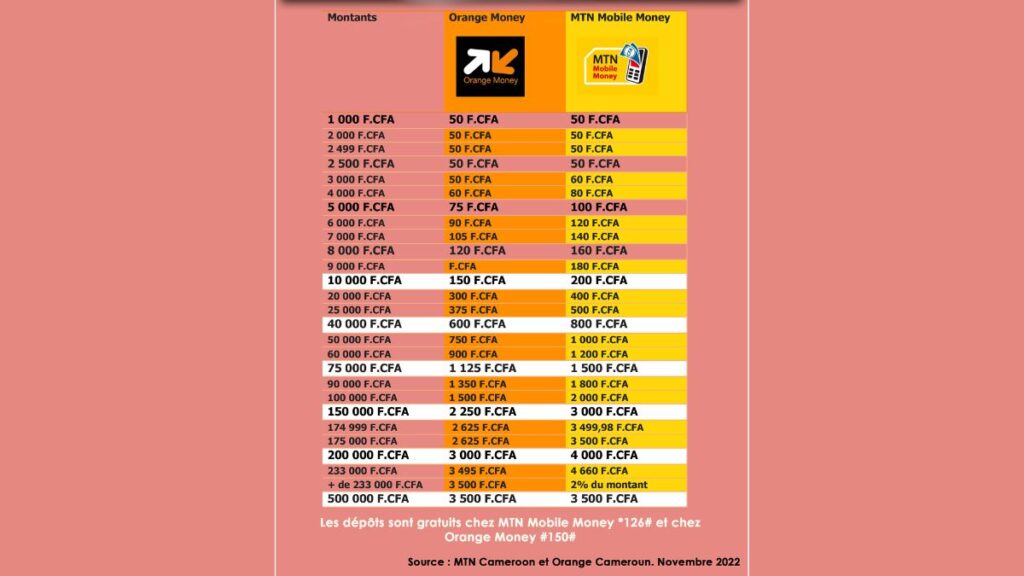
While using mobile money feels like “magic,” it is underpinned by a complex fee structure and a rigorous fiscal framework. In 2026, the cost of a transaction is no longer just the operator’s commission; it includes a layer of government taxes designed to tap into Cameroon’s booming digital economy.
Here is the breakdown of what it costs to move money in 2026.
1. The “Double-Layer” Government Tax
Since the landmark 2022 and 2025 Finance Laws, every time you move money, the state takes a small cut. As of 2026, this consists of two parts:
- The 0.2% Proportional Tax (TTA): This is a tax on the amount you transfer or withdraw. For example, if you send 10,000 FCFA, the tax is 20 FCFA.
- The CFA 4 Fixed Fee: Introduced in 2025, a flat CFA 4 is added to every transfer and withdrawal transaction, regardless of the amount.
- The “Cycle” Effect: Keep in mind that if you send money to someone and they withdraw it, the government collects the 0.2% + 4 FCFA on both ends of the transaction.
2. Operator Commission: The 1% Revolution
To stay competitive against disruptors like Wave, giants like MTN and Orange have largely moved toward a 1% model—but with a catch.
- App vs. USSD: If you use the MoMo App or Max it (Orange), you often benefit from a flat 1% fee for transfers.
- USSD Tiers: If you use the traditional codes (
*126#or#150#), the fees are usually tiered. For example, sending between 10,001 and 13,500 FCFA might cost a flat 100 FCFA plus the government tax.
3. Withdrawal Fees (Cash-Out)
Withdrawing physical cash remains the most expensive part of the process because the operator must pay a commission to the “Call Box” agent.
- The 2026 Standard: Most operators charge roughly 1.5% to 2% for withdrawals.
- Tiered Pricing: For small amounts (e.g., under 5,000 FCFA), the fee is often a fixed amount (around 150–180 FCFA). For large amounts (up to 1,000,000 FCFA), the fee is capped, but the 0.2% tax continues to rise with the amount.
4. What is FREE in 2026?
To encourage the digital shift, several actions remain completely free of charge:
- Cash-In (Deposits): Putting money into your own wallet at an agent’s kiosk.
- Merchant Payments: Paying for groceries, fuel, or restaurant bills via QR code is usually free for the consumer (the merchant pays a small fee instead).
- Tax & Utility Payments: Paying your electricity (ENEO) or water (Camwater) bills, or paying your school fees and government taxes, is typically exempt from the 0.2% transfer tax.
5. Summary Fee Table (Estimated for 2026)
| Transaction Type | Operator Fee | Gov. Tax (0.2%) | Fixed Gov. Fee | Total Impact (Example 10k) |
| Transfer (App) | 1% (100 F) | 20 F | 4 F | 124 FCFA |
| Withdrawal | ~1.7% (175 F) | 20 F | 4 F | 199 FCFA |
| Merchant Pay | 0 F | 0 F | 0 F | 0 FCFA |
| Cash-In | 0 F | 0 F | 0 F | 0 FCFA |
Security: Keeping Your “Momo” Safe
In 2026, as mobile money becomes the primary way Cameroonians store wealth, it has also become the primary target for cybercriminals. While the systems themselves are encrypted and highly secure, the “weakest link” is often the user.
Protecting your “Momo” or “OM” wallet today requires a mix of technical settings and old-fashioned skepticism.
1. The Golden Rule: Your PIN is Sacred
The most common scams in Cameroon aren’t technical hacks; they are “social engineering” attacks.
- The “Fake Agent” Call: You may receive a call from someone claiming to be an MTN or Orange staff member telling you your account is blocked or that you’ve won a prize. They will ask for your PIN to “validate” the process.
- Fact: A real operator will never ask for your PIN. If someone asks for it, hang up immediately.
2. Guard Against the “Wrong Number” Scam
This is a classic that still catches people in 2026.
- How it works: You receive a fake SMS that looks exactly like a deposit notification. Seconds later, a panicked person calls saying they “mistakenly sent money to your number” and begs you to send it back.
- The Fix: Always check your actual balance using
*126#or#150#before believing any SMS notification. If the balance hasn’t increased, the message was a fake.
3. Use Biometrics on Super-Apps
If you use a smartphone, move away from USSD and use the MoMo App or Max it.
- Fingerprint/FaceID: These apps allow you to lock transactions behind biometrics. This means even if someone steals your phone while it’s unlocked, they cannot move your money without your physical fingerprint or face scan.
4. SIM Swap Protection
“SIM Swapping” occurs when a criminal convinces an operator to issue a replacement for your SIM card, giving them total control over your wallet.
- The 2026 Defense: Use the newly introduced safety codes. For example, MTN users can use
*126*15#to block unauthorized withdrawal attempts or*126*14#to ensure only they can initiate a cash-out command. - Signal Loss: If your phone suddenly loses all signal (“No Service”) in an area where you usually have bars, contact your provider immediately from another phone. It could be a sign that someone has cloned your SIM.
5. Secure Your Merchant Payments
When scanning QR codes at a “Call Box” or shop:
- Verify the Name: Before entering your PIN, the screen will show the name of the recipient (e.g., “Confirm payment of 5,000 F to BOUTIQUE BELLE VUE?”).
- Don’t Rush: Fraudulent agents sometimes put their personal QR codes over the official shop code. Always double-check that the name on the screen matches the business you are standing in.
6. What to Do if You are Scammed
If you realize you’ve made a mistake or been defrauded:
- Instant Block: Call 8787 (MTN) or 8900 (Orange) immediately to freeze your account.
- Report to ANIF: For large-scale fraud, you can report the incident to the National Agency for Financial Investigation (ANIF).
- Legal Recourse: In 2026, identity theft and mobile fraud can lead to up to 10 years of imprisonment under Cameroon’s updated cybercrime laws.
The Impact: Financial Inclusion and the Future
In 2026, mobile money is far more than a convenience; it has evolved into the foundational infrastructure for Cameroon’s economic resilience. By bridging the gap between the informal economy and formal financial systems, it is systematically tackling the challenge of financial exclusion.
1. Driving Financial Inclusion
For years, traditional banking remained geographically and socially out of reach for many. Mobile money has democratized access to finance by removing the need for a physical branch or a minimum bank balance.
- The “Unbanked” Solution: Millions of Cameroonians who once relied on “mattress savings” or risky informal tontines now have a secure, digital place to store and track their money.
- Empowering SMEs: Small and medium-sized enterprises—the backbone of Cameroon’s economy—now use mobile money to streamline operations. By digitizing payments, they reduce the time spent on manual accounting and minimize the risks associated with carrying large amounts of cash.
- Gender-Responsive Finance: Studies show that mobile money has been particularly vital for women, providing them with a private, independent means to manage household finances, save, and access micro-credit, often without requiring male guardianship.
2. Resilience and Crisis Response
The true power of this ecosystem was proven during the COVID-19 pandemic, which served as a catalyst for digital government-to-person (G2P) transfers.
- Government-to-Person (G2P) Payments: The government now utilizes mobile wallets to distribute social safety net payments, pensions, and emergency relief directly to beneficiaries. This increases transparency, reduces leakage (theft or administrative loss), and ensures that aid reaches those in need instantly, regardless of their location.
3. The Future: A Highly Connected Landscape
Looking forward, the sector is moving toward a more integrated and sophisticated future. Key trends defining the next few years include:
- Nano-Lending and Digital Credit: Algorithms are now being used to create “alternative credit scores” based on your mobile money transaction history. This allows users who have no credit history at a traditional bank to qualify for small, instant digital loans for emergencies or business inventory.
- Agri-Fintech: As mobile money penetrates deeper into rural areas, we are seeing the emergence of specialized tools for farmers, including mobile-based crop insurance and direct payments for harvests, which help stabilize rural incomes against climate or market shocks.
- The “Super-App” Era: As competition intensifies between players like MTN, Orange, Wave, and the newcomer Blue Money, expect “super-apps” to become the norm. These apps will likely integrate e-commerce, transport booking, healthcare access, and insurance into a single, seamless digital lifestyle hub.
- Cross-Border Trade: With the African Continental Free Trade Area (AfCFTA) taking center stage, mobile money is expected to become the primary vehicle for cross-border small-scale trade, potentially supported by blockchain-based settlements to reduce currency conversion costs within the CEMAC zone.
Conclusion: Why Mobile Money is Here to Stay
In 2026, mobile money is the “operating system” of the Cameroonian economy. While challenges like cybersecurity and the impact of taxation remain, the trajectory is clear: the era of paper cash is receding, replaced by a digital, inclusive, and highly efficient financial ecosystem. For the individual, the merchant, and the nation, this is not just a technological upgrade—it is the key to unlocking long-term economic growth and social equity across the Triangle.