
⚡ Quick Summary: Cameroon’s Debt in 2026
Key Takeaway: Cameroon is not in an immediate debt default crisis, but rapidly escalating servicing costs are putting a heavy squeeze on national liquidity.
Here are the essential figures and insights every investor, policy analyst, and citizen needs to know right now:
- Total Public Debt Stock: 15,607 Billion XAF (~$27.5 Billion USD) as of mid-2026.
- Debt-to-GDP Ratio: 44.2%. This sits safely below the 70% CEMAC regional ceiling and Cameroon’s national strategy threshold of 50%.
- External vs. Domestic Split: Central administration debt is 64.5% External (foreign loans) and 35.5% Domestic (treasury bonds, local banks, and arrears).
- Top Creditors: China (Exim Bank of China) dominates bilateral debt, while multilateral institutions (IMF, World Bank, AfDB) hold the largest share of low-interest concessional debt.
- The Real Bottleneck: Debt Servicing. In the first half of 2026 alone, the state spent over 1,059 Billion XAF on debt repayments—siphoning vital cash flow away from local infrastructure and public services.
Introduction: The $27.5 Billion Question
Let’s be honest about something:
Most guides on national debt are painful to read.
They dump endless tables of jargon, cite outdated figures from 2018, and leave you more confused than when you started.
This guide is different.
Advertisement
Today, we are opening up the books on Cameroon’s national balance sheet. No political spin. No economic fluff. Just cold, hard data sourced directly from the Caisse Autonome d’Amortissement (CAA), the Ministry of Finance, and the IMF.
Here is the reality: As of 2026, Cameroon’s public debt stands at 15,607 Billion XAF (~$27.5 Billion USD).
Total Debt: 15,607 Billion XAF
Debt-to-GDP: 44.2%
External/Domestic: 64.5% / 35.5%
Is this debt load a ticking time bomb that threatens to derail Africa’s central economic engine?
Or is it a calculated, necessary investment to build the ports, power grids, and highways needed for Vision 2035?
Whether you are an investor evaluating CEMAC sovereign bonds, an entrepreneur in Douala managing cash flow, or a citizen wondering where tax revenues are going—this is your ultimate, data-backed guide to understanding Cameroon’s debt situation in 2026.
Let’s dive right in.
Chapter 1: The Raw Numbers (How Much Does Cameroon Actually Owe?)
Before evaluating financial risk, let’s establish the baseline data.
How much money does the Republic of Cameroon owe right now?
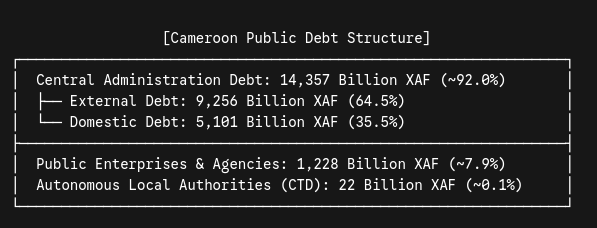
According to official data from the Caisse Autonome d’Amortissement (CAA)—the official agency managing Cameroon’s public debt—total public debt reached 15,607 Billion XAF (approx. $27.5 Billion USD).
Here is the exact breakdown of that total balance sheet:
1.1 The External vs. Domestic Split
To understand sovereign debt, you have to split it into two distinct buckets:
Advertisement
Bucket #1: External Debt (64.5% of Central Administration Debt)
This is money owed to foreign creditors—multilateral banks, foreign governments, and international bondholders.
- Total Amount: 9,256 Billion XAF.
- The Key Trait: Most of this debt is denominated in foreign currencies (US Dollars, Euros, Special Drawing Rights, Yuan).
Bucket #2: Domestic Debt (35.5% of Central Administration Debt)
This is money owed inside the country (or within the CEMAC monetary zone).
- Total Amount: 5,101 Billion XAF.
- The Key Trait: It consists of Treasury Bonds (Obligations du Trésor Assimilables – OTA), Treasury Bills (Bons du Trésor Assimilables – BTA), commercial bank loans, and structural arrears owed to local Cameroonian suppliers.
1.2 The Debt-to-GDP Myth: Is 44.2% Safe?
You will often hear commentators and policy makers say:
“The CEMAC regional debt ceiling is 70% of GDP. Cameroon is only at 44.2%. Therefore, the debt level is completely safe!”
Not so fast.
While a 44.2% Debt-to-GDP ratio looks comfortable compared to Western nations (or African peers like Ghana or Kenya whose debt ratios surged past 70-80%), GDP does not pay back debt—tax revenues do.
Here is the key distinction every analyst must understand:
Advertisement
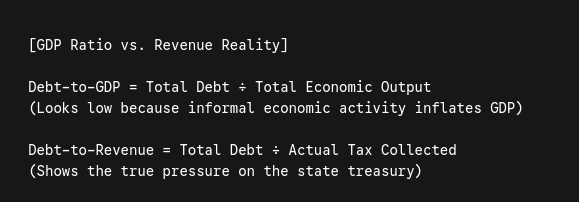
Because Cameroon’s tax-to-GDP ratio hovers around 12-13% (below the Sub-Saharan African average of ~16%), the country collects less cash in taxes relative to the size of its economy.
The Bottom Line: A low Debt-to-GDP ratio can hide significant liquidity friction if tax collection lags behind.
Chapter 2: Who Does Cameroon Owe? (Creditor Breakdown)
Not all debt is created equal.
Borrowing $100 million from a multilateral development bank at a 1.5% interest rate over 30 years is completely different from issuing a 10-year Eurobond at 8.5% interest.
To truly judge Cameroon’s financial health, we have to look under the hood at who holds the IOUs.
Here is how Cameroon’s 9,256 Billion XAF in external central government debt breaks down by creditor type:

Let’s break down each category.
Advertisement
2.1 Multilateral Creditors (48.2% of External Debt)
Multilateral debt is the “safest” form of sovereign borrowing. These are institutions created by groups of countries to promote economic development.
- The Key Lenders: The World Bank (IDA), the International Monetary Fund (IMF), and the African Development Bank (AfDB).
- Why it’s good: Terms are highly concessional—meaning low interest rates (often under 2%), long grace periods (5–10 years), and extended repayment horizons (up to 30 years).
- The Catch: It comes with strict economic conditionalities—such as mandatory digitization of tax systems, reduction of fuel subsidies, and public asset audits under the IMF Extended Credit Facility (ECF).
2.2 Bilateral Creditors (38.6% of External Debt)
Bilateral debt consists of direct loans from foreign governments and their official export-import banks.
1. China (Exim Bank of China)
Make no mistake: China is Cameroon’s single largest bilateral creditor.
China holds roughly 60% of all Cameroonian bilateral debt. These funds directly financed landmark “First Generation” infrastructure projects:
- The Kribi Deep-Water Port (Phases 1 & 2)
- The Memve’ele Hydroelectric Dam (211 MW)
- The Yaoundé-Douala Expressway (Phase 1)
- The Ebolowa-Kribi Road Network
While Chinese loans allowed Cameroon to build critical assets fast, the debt profile is mostly commercial or semi-concessional, meaning higher interest rates and shorter maturities than World Bank loans.
2. Paris Club Nations (France, Germany, Japan)
- France (AFD): Historically a major creditor, much of France’s official debt has been converted via C2D (Debt Reduction-Development Contracts)—where debt repayments are recycled back into local development projects (schools, urban roads, agriculture).
- Germany & Japan (JICA): Provide smaller, highly targeted concessional loans for environmental preservation, rural electrification, and water infrastructure.
2.3 Commercial Debt & Eurobonds (13.2% of External Debt)
This is market-rate debt borrowed from international private banks and global bond markets.
- Eurobonds: Cameroon’s international bond issuances listed on global exchanges (like London or Dublin).
- Commercial Syndicates: Short-to-medium term loans from international banking syndicates.
The Bottom Line on Commercial Debt: While it accounts for a smaller percentage of total debt, it is by far the most expensive to service due to market-driven interest rates and dollar exchange rate volatility.
2.4 The Domestic Market (35.5% of Total Central Government Debt)
Cameroon doesn’t just borrow internationally—it is a major player on the regional money market managed by the Bank of Central African States (BEAC).
Domestic debt (5,101 Billion XAF) consists of three key components:
- Obligations du Trésor Assimilables (OTA): Medium-to-long term treasury bonds issued to institutional investors (banks, insurance companies) across the CEMAC region.
- Bons du Trésor Assimilables (BTA): Short-term liquidity instruments (under 52 weeks) used to smooth out monthly state cash flow.
- Structured & Unstructured Arrears: Pending payments owed to local businesses, construction firms, and state suppliers.
Key Insight: Local currency debt (OTA/BTA) carries zero currency risk because it is issued in Francs CFA (XAF). However, interest rates on the BEAC regional market have risen as the central bank tightened monetary policy to fight inflation.
Chapter 3: How Did We Get Here? (Drivers of Accumulation)
Here is a number that will blow your mind:
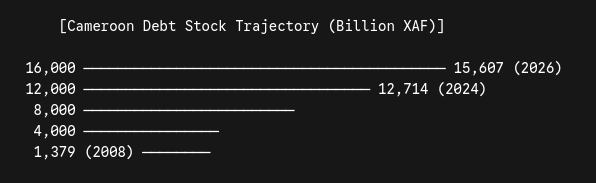
In 2008, following the Highly Indebted Poor Countries (HIPC) completion point relief, Cameroon’s public debt stock was just 1,379 Billion XAF.
By mid-2026, that figure hit 15,607 Billion XAF.
That is a 1,000%+ increase in under two decades.
How did we get here? Did government spending simply run wild?
Not quite.
The surge in Cameroon’s debt stock was driven by four massive structural economic engines.
Engine #1: The Big Infrastructure Push (“Vision 2035”)
After wiping the slate clean with HIPC debt relief in the mid-2000s, Cameroon faced a brutal reality:
Its infrastructure was severely outdated. Power cuts crippled businesses, ports were congested, and roads between major economic hubs were unpaved.
To fix this, the government launched a series of mega-projects under its Vision 2035 and SND30 economic blueprints.
These required massive, front-loaded Capital Expenditure (CapEx) funded primarily through foreign debt:
- Energy: Construction of the Memve’ele Dam (211 MW), Nachtigal Hydroelectric Project (420 MW), and Lom Pangar.
- Maritime: The multi-phase Kribi Deep-Water Port (financed largely via Exim Bank of China).
- Transport: The Yaoundé-Douala Expressway, Yaoundé-Nsimalen Highway, and extensive regional road corridors.
The Bottom Line: You can’t build world-class ports and hydro dams on tax revenue alone. The state borrowed aggressively to build physical assets.
Engine #2: External Economic Shocks
Even the best-laid infrastructure plans can get derailed by global market forces.
Three distinct external shocks forced Cameroon to borrow just to cover sudden budget deficits:
- The 2014–2016 Oil Price Crash: Crude oil historically accounted for a massive chunk of Cameroon’s export earnings. When prices collapsed from $100+/barrel to under $30, state revenues evaporated overnight, forcing the government to borrow for operational cash flow.
- The 2020 Global Pandemic: Trade disruptions froze tax collection while demanding emergency public health and social spending.
- Post-2022 Global Inflation & Interest Rate Hikes: As western central banks raised interest rates to fight inflation, borrowing costs on international markets (like Eurobonds) skyrocketed, making debt refinancing significantly more expensive.
Engine #3: Regional Security & Humanitarian Pressures
National defense doesn’t come cheap.
Over the past decade, Cameroon has had to simultaneously manage two major security crises:
- The Boko Haram / ISWAP Insurgency in the Far North Region.
- The Anglophone Crisis in the Northwest and Southwest Regions.
Ramping up military deployments, procurement of defense materiel, and managing internal displacement siphoned billions out of the civil budget—forcing the Ministry of Finance to plug the gap with short-term Treasury Bills (BTA) and domestic bank debt.
Engine #4: Structural Subsidies & Distressed State Enterprises
Finally, we have to talk about contingent liabilities—debt originating from inefficient state-owned enterprises (SOEs) that ultimately lands on the national balance sheet.
  [The State Enterprise Debt Cycle]

  SOE Operates at a Loss ➔ Accumulates Debt ➔ State Guarantees/Absorbs Debt ➔ National Debt Increases
- Fuel Subsidies: For years, the state spent hundreds of billions of XAF annually subsidizing pump prices for gasoline and diesel to protect consumers, starving the treasury of cash.
- State Enterprises (SOEs): Key public agencies—including the state oil refinery (SONARA) following its 2019 fire, utility providers, and transport authorities—hold roughly 923 Billion XAF in direct debt, with explicit state-guaranteed liabilities adding even more to the public burden.
Chapter 4: Debt Servicing (The True Pressure Point)
Here is the single most important lesson in sovereign finance:
Countries rarely collapse because their total debt is high. They collapse because they run out of cash to pay debt servicing costs.
Think of debt servicing as your monthly mortgage payment. It doesn’t matter if your house is worth billions—if your paycheck can’t cover this month’s installment, you have a crisis.
And for Cameroon, that monthly bill has reached an all-time high.
4.1 The Raw Numbers: 1,059 Billion XAF in Just Six Months
According to the July 2026 debt report published by the Caisse Autonome d’Amortissement (CAA), the Cameroonian state spent a staggering 1,059.3 Billion XAF on debt servicing in the first six months of 2026 alone.
To put that into perspective: That is a +39.5% surge compared to the same period in 2025.
Here is how that 1,059.3 Billion XAF cash outflow breaks down:
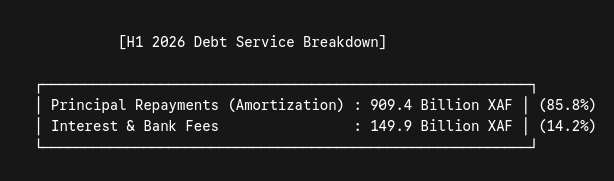
For the entire 2026 budget year, the government has earmarked 2,420.1 Billion XAF strictly for debt service payments.
4.2 Where Does the Interest Money Go?
When it comes to paying interest alone (149.9 Billion XAF in H1 2026), where is the cash flowing?

- External Debt absorbed 69.2% of all interest payments (104.7 Billion XAF).
- Domestic Debt absorbed the remaining 30.8% (46.2 Billion XAF).
4.3 The Opportunity Cost: The Great Budget Squeeze
Now, let’s connect this to real-world impact.
Every Franc CFA set aside for debt servicing is a Franc CFA that cannot be spent on domestic development.
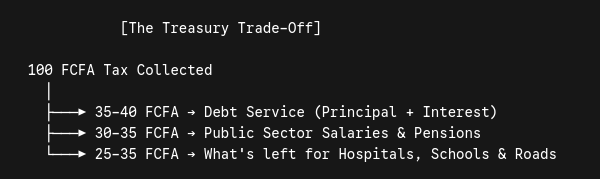
When debt servicing consumes more than a third of total state revenues, government cash flow gets squeezed instantly.
The result?
- Delayed Payments to Local Suppliers: Accumulation of internal arrears, which suffocates domestic SMEs and halts local construction.
- Postponed Infrastructure: Non-urgent public works are delayed or put on ice.
- Dependence on Short-Term Paper: The Treasury is forced to continuously issue short-term Bons du Trésor (BTA) on the BEAC regional market just to meet month-end payroll and debt maturities.
4.4 The Verdict on Debt Servicing
The high level of debt servicing is Cameroon’s primary vulnerability.
While the state has never defaulted on its sovereign commitments, maintaining this repayment rhythm requires intense fiscal discipline, continued support from the IMF, and aggressive tax collection.
Chapter 5: Risks, Refinancing & The IMF Safety Net
Is Cameroon on the verge of a sovereign debt crisis?
If you listen to casual observers, the answer sounds alarming.
However, if you look closely at the institutional data, the reality is far more nuanced.
Cameroon is not facing a default, but it is managing a delicate economic balancing act.
Let’s dissect the three primary structural risks facing the country’s debt portfolio—and how financial authorities are navigating them.
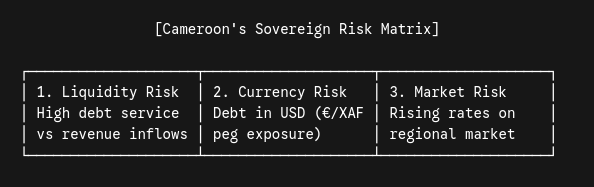
Risk #1: The IMF Rating (“High Risk of Debt Distress”)
The International Monetary Fund (IMF) and the World Bank consistently classify Cameroon as being at high risk of external debt distress.
Understanding what that label actually means is crucial:
- It is NOT an indicator of insolvency: The overall Debt-to-GDP ratio (~44.2%) remains well below the regional 70% limit.
- It IS an indicator of tight liquidity: The rating reflects the fact that external debt service payments absorb a disproportionate share of exports and state revenues.

To maintain stability, the IMF requires the government to maintain a strict non-oil primary fiscal deficit balance and limit non-concessional borrowing.
Risk #2: Currency Mismatch & USD Exposure
A significant portion of Cameroon’s external debt is denominated in foreign currencies—primarily the US Dollar ($).
Because the Franc CFA (XAF) is pegged to the Euro (€), any sharp depreciation of the Euro against the Dollar automatically increases the cost of servicing dollar-denominated loans in local currency terms.
How Yaoundé Mitigated This Risk:
To insulate the budget against dollar volatility, the Ministry of Finance executed financial hedging strategies:
The USD/EUR Currency Swap Strategy: During the $750 million Eurobond private placement, the government executed a cross-currency swap via Cygnum Capital, convert-hedging the USD liability into Euros. This effectively reduced the effective coupon rate from 10.125% in USD down to ~7.79% in Euro-linked terms.
Risk #3: Refinancing & Eurobond Rollover Strategies
Managing maturing international debt requires active market presence.
When market interest rates spiked globally, sovereign bond issuance became significantly more expensive across Sub-Saharan Africa.
To prevent repayment shocks, Cameroon deployed proactive Liability Management Operations (LMOs):

By replacing maturing short-term debt with extended 7-to-10-year maturities, the Caisse Autonome d’Amortissement (CAA) successfully smoothed out the repayment curve, avoiding a single “debt cliff”.
The IMF Safety Net: Anchoring Reform
Cameroon’s multi-year agreements under the Extended Credit Facility (ECF), Extended Fund Facility (EFF), and Resilience and Sustainability Facility (RSF) serve three critical functions:
- Catalytic Effect: IMF approval acts as a green light for other international lenders (World Bank, AfDB, French Development Agency) to release low-cost concessional financing.
- Structural Fiscal Anchors: The program forces key structural reforms—such as eliminating SNH direct intervention spending outside the central budget framework, rationalizing tax incentives, and restructuring state enterprises.
- Market Confidence: Demonstrating adherence to IMF performance targets reduces the risk premium demanded by international investors on private placements.
Chapter 6: The Action Plan (How Cameroon Can Turn the Tide)
How does Cameroon reduce debt vulnerabilities without choking off economic growth?
The answer isn’t simply “spend less.”
Cutting public investment in ports or power grids would stall GDP growth, making the Debt-to-GDP ratio worse, not better.
Instead, the Ministry of Finance, the Direction Générale des Impôts (DGI), and financial authorities are executing a four-part strategy to rebalance the national ledger.
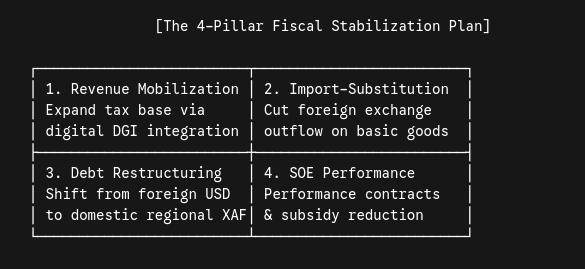
Let’s break down how each pillar works on the ground.
Pillar 1: Digital Revenue Mobilization (Expanding the Tax Base)
Cameroon’s tax revenue hovers around 12.3% of GDP. The IMF target for sustainable fiscal health is at least 15%.
Rather than raising tax rates on formal corporate taxpayers—which harms business competitiveness—the DGI is leveraging technology to capture the vast informal economy:
- Digital Tax Identification: Mandatory use of Unique Identification Numbers (NIU) for banking, mobile money merchant accounts, and public contracts.
- E-Filing & Automated Audits: Systematic cross-referencing between Customs (Douanes) and Tax (Impôts) databases to prevent under-invoicing.
- Non-Tax Revenue Optimization: Streamlining the collection of administrative fees, land registration duties, and state asset royalties.
The Target: Increase non-oil tax collection by 0.5% to 1.0% of GDP annually to cover debt service without extra borrowing.
Pillar 2: Import-Substitution (SND30 Strategy)
Every time Cameroon imports rice, fish, wheat, or palm oil, the country spends foreign currency reserves—reserves that are needed to pay off dollar-denominated foreign loans.
Under the National Development Strategy 2020–2030 (SND30), the government is executing an aggressive import-substitution policy:
  [Import-Substitution Economic Loop]

  Local Agriculture Production ➔ Reduced FX Outflow ➔ Stronger Foreign Reserves ➔ Safer External Debt Payments
- Tariff Incentives: Applying higher customs duties on imported agricultural goods while offering tax exemptions on imported agricultural machinery.
- Local Content Directives: Requiring public institutions (military, schools, state hospitals) to source food and textiles from domestic producers.
- Agro-Industrial Support: Directing financing toward key domestic value chains (maize, rice, cassava, sorghum) to reduce trade deficits.
Pillar 3: Debt Restructuring & Domestic Market Preference
To eliminate exchange rate risk, the Caisse Autonome d’Amortissement (CAA) is shifting its borrowing model away from foreign currency commercial debt toward the regional market.
- Leveraging the BEAC Money Market: Issuing long-term Obligations du Trésor Assimilables (OTA) in local XAF currency across the CEMAC region.
- Eliminating FX Volatility: Local currency debt carries zero exchange rate risk because the XAF is linked to the state’s domestic revenue base.
- Concessional Prioritization: Restricting external borrowing strictly to low-interest, long-maturity loans from multilateral development partners (World Bank, AfDB).
Pillar 4: Restructuring State-Owned Enterprises (SOEs)
Off-balance-sheet debt from state enterprises has historically created unexpected fiscal shocks.
To close this leak, Cameroon is enforcing structural enterprise governance reforms under its IMF program:
- Performance Contracts: Implementing binding socioeconomic performance benchmarks for major public agencies to eliminate systematic state bailouts.
- SONARA Debt Restructuring: Finalizing structured repayment frameworks with banking syndicates and crude suppliers following the refinery fire.
- Subsidy Rationalization: Gradually replacing broad fuel pump subsidies with targeted social safety net transfers (National Solidarity Fund) to protect vulnerable households without draining the treasury.
Conclusion & The Bottom Line
Let’s step back and summarize the current state of Cameroon’s public debt.
If you strip away the political commentary and focus purely on the fiscal balance sheet, three fundamental takeaways emerge:
- Cameroon is NOT on the brink of default. With a Debt-to-GDP ratio of 44.3%, total debt remains structurally sustainable and well beneath both the national 50% target and CEMAC’s 70% regional cap.
- Liquidity is the true operational bottleneck. The challenge isn’t the debt mountain itself—it’s the debt service rhythm. Paying over 1,000 Billion XAF every six months puts immediate pressure on the state treasury, creating payment delays for domestic suppliers and contractors.
- The management model is improving. Through active Eurobond liability management, a pivot toward regional XAF-denominated bonds, and DGI digitization, financial authorities are mitigating exchange-rate and refinancing risks.
The ultimate key to long-term debt sustainability isn’t just spending less—it’s growing faster.
If major capital infrastructure—from the Kribi Deep-Water Port to the Nachtigal hydro-grid—continues to unlock private sector investment and drive economic expansion, Cameroon’s debt burden will naturally shrink as a percentage of the broader economy.
❓ Frequently Asked Questions (FAQ Section)
Q1: How much public debt does Cameroon owe in 2026?
As of mid-2026, Cameroon’s total public debt stands at approximately 15,607 Billion XAF (approx. $27.5 Billion USD), according to official data from the Caisse Autonome d’Amortissement (CAA). Central government administration accounts for roughly 92% of this total, while state-owned enterprises and local authorities hold the remaining share.
Q2: Is Cameroon’s Debt-to-GDP ratio dangerously high?
At 44.2%, Cameroon’s Debt-to-GDP ratio sits comfortably below the 70% ceiling mandated by the Central African Economic and Monetary Community (CEMAC) and beneath the national strategy cap of 50%. While the total debt volume is considered structurally sustainable, high annual debt servicing obligations create cash flow and liquidity pressures for the state treasury.
Q3: Who is Cameroon’s largest single creditor?
On a bilateral level, China (Exim Bank of China) is Cameroon’s largest single creditor, holding approximately 60% of all bilateral debt. Chinese loans have primarily financed major infrastructure projects, including the Kribi Deep-Water Port, the Memve’ele Hydroelectric Dam, and the Yaoundé-Douala Expressway. On a broader institutional level, multilateral development banks (such as the World Bank, IMF, and AfDB) collectively hold the largest share of overall external debt at 48.2%.
Q4: Why does the IMF classify Cameroon at “High Risk of Debt Distress”?
The IMF and World Bank assign a “high risk” rating to Cameroon due to liquidity constraints and debt service timing, rather than total insolvency. Servicing public debt requires significant cash outflows—over 1,059 Billion XAF in the first half of 2026 alone—which consumes more than a third of annual tax revenues and leaves the budget vulnerable to foreign exchange fluctuations (such as USD/EUR shifts) and global economic shocks.

