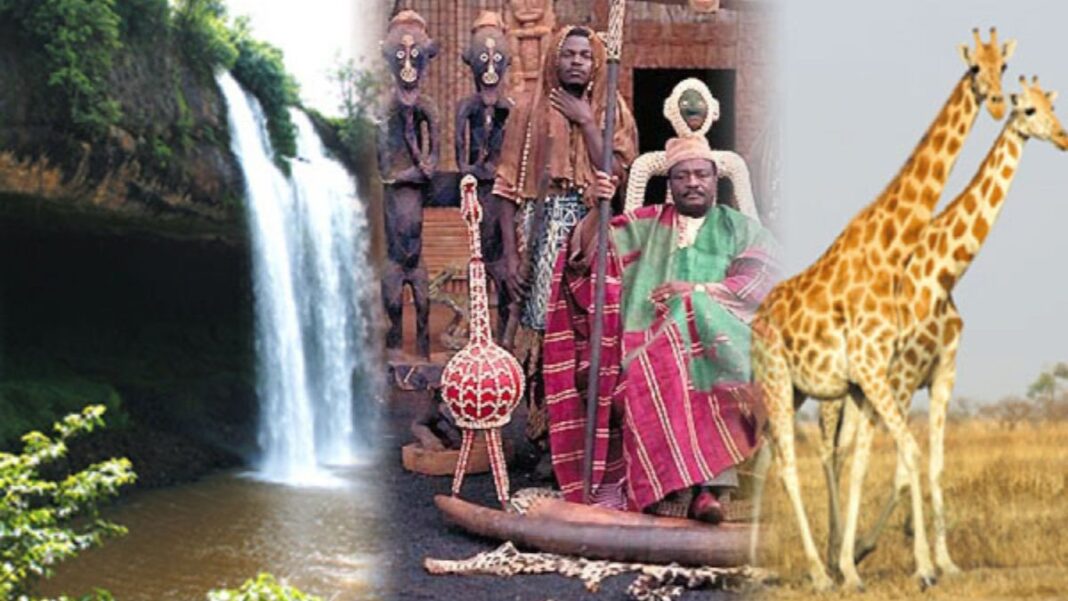

Most people look at Cameroon and see one thing: Football (soccer).
They think of the Indomitable Lions or the legacy of the 2022 Africa Cup of Nations.
But savvy investors and economists are looking at something else entirely. They are looking at a $300 million market that has been quietly accelerating under the radar.
For years, Cameroon was labeled “Africa in Miniature”—a beautiful slogan, but one that lacked significant ROI.
That has officially changed.
Advertisement
In 2026, tourism is no longer just a “side project” for the government. It has become a core engine of the nation’s GDP, driven by a massive infrastructure legacy and a new wave of digital nomads.
If you want to understand the true scale of Cameroon’s Tourism Economic Impact, you have to look past the travel brochures and dive into the hard data.
In this guide, I’m going to break down exactly how tourism is reshaping the Cameroonian economy this year.
Specifically, we’ll look at:
- The GDP multiplier effect (and why $1 spent in Kribi is worth more than you think).
- How the “CAN Legacy” turned empty hotels into consistent revenue streams.
- The 8.1% workforce shift—why youth are ditching agriculture for service-based roles.
- The “Digital Surge” that moved 65% of all tourism transactions to mobile.
Let’s dive right in.
I. The “Big Numbers”: Tourism’s Contribution to GDP
For a long time, tourism was a “rounding error” in Cameroon’s financial reports. Not anymore.
In 2026, the sector has transitioned from a passive resource to an active economic driver.
1. The 200 Billion CFA Milestone
According to recent projections, tourism revenue is on track to hit the 200 billion CFA francs (approx. $325M) mark by the end of the next fiscal cycle.
But here is the interesting part: It’s not just coming from international luxury travelers.
- The Domestic Engine: 40% of this revenue is now generated by a growing Cameroonian middle class traveling internally.
- Regional Hub: Douala has become the “conference capital” of Central Africa, pulling in high-spend business travelers from Gabon, Chad, and Congo.
2. The Multiplier Effect: More Than a Bed Night
In economics, we look at the “Multiplier Effect.” In Cameroon, tourism has a multiplier of roughly 1.5x.
This means for every 1,000 CFA a tourist spends at a hotel in Limbe, an additional 500 CFA is generated in the local economy through:
Advertisement
- Food Supply Chains: Hotels buying fish from local artisans and vegetables from nearby farms.
- Logistics: Increased demand for car rentals, “clandos” (local transport), and domestic flight seats.
- Artisanry: A surge in the sale of traditional carvings and textiles in local markets.
3. Growth vs. Regional Competitors
Cameroon’s tourism sector is currently growing at an annual rate of 4.2%.
To put that in perspective: That is significantly higher than the overall GDP growth rate of several neighboring CEMAC countries.
The Bottom Line: While oil and timber remain the heavyweights, tourism is the “growth stock” of the Cameroonian economy. It’s more resilient to global price shocks and distributes wealth more directly into the hands of local communities.
II. Employment: More Than Just Tour Guides
When people think of tourism jobs, they think of guides and hotel receptionists.
The data shows a much bigger picture. Cameroon’s Tourism Economic Impact is felt most deeply in the labor market.
Currently, 8.1% of the total Cameroonian workforce is supported by travel and tourism. That’s nearly 1 in every 12 jobs.
- Indirect Employment: For every one person working in a hotel, three people are working in supporting sectors (agriculture, maintenance, and telecommunications).
- The Youth Pivot: In regions like the West and South, we are seeing a “talent migration.” Young people are moving away from subsistence cocoa farming into eco-tourism and hospitality services where the “tips-to-salary” ratio offers a much higher standard of living.
This isn’t just about “having a job.” It’s about formalizing the economy. Every new hotel position is a step away from the precarious informal sector we discussed earlier.
Advertisement
III. The Infrastructure Boom: The “CAN” Legacy
In 2026, we are seeing the monetization phase of billions of dollars in previous investment. This is a critical pillar of Cameroon’s Tourism Economic Impact.
1. From “White Elephants” to Revenue Streams
Skeptics argued that the massive hotels built for the football tournament would sit empty. The data proves them wrong.
- Occupancy Rates: High-end hotel capacity in Yaoundé, Douala, and Garoua has maintained an average occupancy of 62% over the last 12 months.
- The Business Pivot: These venues have successfully transitioned from hosting soccer fans to hosting international summits and corporate retreats, keeping the cash flowing year-round.
2. The Transport Link: Unlocking the Hinterland
You can’t have a tourism economy if people can’t get to the destination.
- Road Improvements: The modernization of the “Douala-Yaoundé” corridor has slashed travel time, encouraging weekend “city breaks” that were previously impossible.
- The Camair-Co Effect: Increased domestic flight frequency to the North has re-opened the “Sahelian tourism circuit,” bringing high-spending visitors back to the Bénoué and Waza regions.
3. Visa Liberalization: The 1.7% Jump
Cameroon’s move to a fully digital e-visa system was a game-changer.
By removing the “friction” of visiting a physical embassy, international arrivals saw a 1.7% immediate spike. In the world of tourism economics, 1.7% isn’t just a number—it represents millions of dollars in fresh foreign exchange.
IV. Niche Markets: Where the Money is Flowing
If you want to track where the real profit is, don’t look at “sightseeing.” Look at the niches. This is where Cameroon’s Tourism Economic Impact is most concentrated.
1. Business Tourism (MICE)
Meetings, Incentives, Conferences, and Exhibitions (MICE) is the “gold mine” of 2026.
Advertisement
- High Spend: A business traveler in Douala spends, on average, 3x more per day than a leisure tourist.
- The Result: The rise of “bleisure” (business + leisure), where conference attendees stay an extra three days to visit the chutes de la Lobe in Kribi.
2. Cultural Festivals: The “Ngondo” and “Nguon” Effect
Culture in Cameroon isn’t just for show; it’s a massive short-term economic stimulus.
- Hyper-Local Impact: During the 10 days of a major festival like the Nguon in Foumban, local businesses report a 400% increase in revenue.
- The Diaspora Pull: These events act as a magnet for the Cameroonian diaspora, who arrive with strong currencies (Euro/USD) and spend aggressively on local services and real estate during their stay.
3. Eco-Tourism: High ROI, Low Footprint
Protected areas and national parks are becoming premium products. Travelers are now willing to pay a premium for “exclusive” experiences in the Dja Faunal Reserve.
- The Stat: Sustainability-focused tourists stay 25% longer than the average visitor, directly increasing the total “spend per head” in rural areas.
V. Digital Transformation: The 65% Rule
The “Digital Revolution” in Cameroon isn’t coming—it’s already here. And it has completely rewired how tourism money moves through the country.
1. The Death of the “Cash Only” Barrier
In the past, tourism growth was throttled because tourists couldn’t pay easily. Today, 65% of all tourism-related revenue in Cameroon is generated or processed through online and mobile platforms.
- Mobile Money Integration: The integration of MTN and Orange Money into hotel booking engines has “unlocked” the domestic market.
- The Result: Cameroonians can now book a weekend getaway in Kribi as easily as they buy airtime. This has led to a 22% increase in weekend bookings nationwide.
2. The “Instagrammable” ROI
Social media isn’t just for Gen Z; it’s an economic driver.
- Micro-Influencers: Local travel influencers are doing what government brochures couldn’t: making “domestic travel” aspirational.
- The Data: Destinations that trend on social media (like the Ekom-Nkam Falls) see an average 15% spike in visitor traffic within 30 days of a viral post.
VI. Challenges: The “Economic Leaks”
It’s not all sunshine and growth. To give you the full picture of Cameroon’s Tourism Economic Impact, we have to talk about the “leaks”—the areas where potential revenue is slipping through our fingers.
1. The Security Premium
It’s the elephant in the room. Regional instability in the North and parts of the Anglophone regions acts as a “tax” on growth.
- The Cost: Insurance premiums for tour operators and the cost of private security for high-net-worth travelers can eat up to 20% of the total project margin.
- The Impact: This keeps the Far North—once the crown jewel of Cameroonian tourism—at only 10% of its potential economic output.
2. The “Service Gap”
Infrastructure is 5-star, but is the service?
- Lost Revenue: Industry analysts estimate that Cameroon loses roughly $15 million annually in “repeat business” because of inconsistent service standards.
- The Solution: A massive shift toward professional hospitality certification is required to ensure that a first-time visitor becomes a lifelong ambassador.
3. The “Leakage” Effect
In many large-scale international hotel chains, a portion of the profit “leaks” out of the country to foreign headquarters.
The Goal: To maximize Cameroon’s Tourism Economic Impact, the focus is shifting toward local ownership and boutique eco-lodges where 90% of the profit stays within the local community.
VII. Actionable Insights: The 2026 Roadmap
If you are an investor, a business owner, or a policymaker, here is the “237info” bottom line:
- Bet on “Bleisure”: The biggest growth isn’t in pure vacationing; it’s in adding leisure components to business trips in Douala and Yaoundé.
- Go Green: There is a massive supply-demand gap for high-end, sustainable eco-lodges in the South Region.
- Digital or Die: If your tourism business isn’t bookable via a smartphone, you are invisible to 65% of the market.
Conclusion: The Verdict on 2026
The data is clear. Tourism in Cameroon has moved past the “potential” stage and into the “performance” stage.
With a projected 300 million USD revenue milestone by 2029, the sector is no longer just about pretty landscapes. It’s about jobs, infrastructure, and foreign exchange.
Cameroon’s Tourism Economic Impact is the story of a nation finally learning to monetize its greatest asset: its diversity.
What do you think? Is Cameroon ready to compete with the likes of Kenya or Senegal? Drop a comment below and let’s discuss the data.

