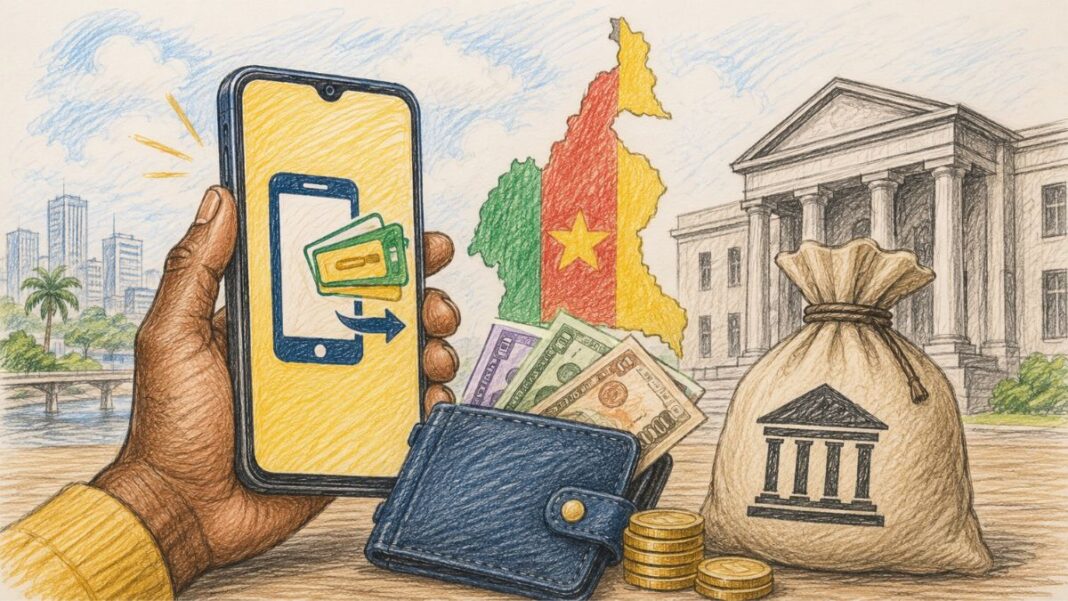

If you’re sending or receiving money in Cameroon today, you’ve likely noticed your balance dropping faster than expected.
It’s not a glitch.
The 2026 Finance Law has officially overhauled mobile money taxes, introducing new levies that affect everything from basic transfers to gambling withdrawals and even international digital services.
In this guide, I’m going to break down exactly how much you’re being taxed, why the rules changed, and—most importantly—the few legal ways you can minimize the impact on your wallet.
Let’s dive in.
Advertisement
1. The State of Mobile Money Taxation (The “What’s New” Section)
Taxation on digital payments in Cameroon isn’t exactly “new,” but it has become significantly more complex.
To understand where we are, we have to look back.
In 2022, the government introduced a 0.2% tax on money transfers, which sparked a nationwide debate. For a long time, this was the baseline. However, as the digital economy expanded, the government sought to broaden the tax base to include more than just simple person-to-person (P2P) transfers.
Enter the Cameroon 2026 Finance Law.
This latest legislation has introduced a specific XAF 4 fixed tax per transaction for credit institutions and microfinance institutions. While 4 francs sounds small, the cumulative effect on high-frequency users is massive.
But it doesn’t stop at transfers.
The 2026 update also targets the gambling industry. If you are a fan of sports betting, you should know that a 1% levy now applies to withdrawals from gaming platforms. This means your winnings are being taxed before they even hit your digital wallet.
If you are feeling overwhelmed by these changes, you aren’t alone. I’ve previously written a deep dive into the Cameroon 2026 Finance Law that breaks down the broader economic implications for the country.
The reality? Mobile money taxes are no longer just a flat fee—they are a multi-layered system designed to capture revenue from every corner of the digital ecosystem.
Ready to see how the math actually works on your next transaction? Let’s look at the mechanics.
2. How Mobile Money Taxes Work in 2026 (The “How-To” Data)
How much does it actually cost to move money in 2026?
Advertisement
It’s the question everyone is asking, but the answer depends entirely on how you move it. The new regulations have created a clear distinction between internal transfers, withdrawals, and merchant payments.
First, you have the 0.2% transfer tax. This remains the “standard” fee applied when you send money from your phone to another person. However, under the new regime, there is a tighter grip on how this interacts with the mobile money taxes applied at the point of withdrawal.
To make this clear, look at this breakdown of the current landscape:
| Transaction Type | Tax Rate / Fee | Applied By |
| P2P Transfer | 0.2% of amount | Government (DGI) |
| Withdrawal (Cash-out) | Varies by provider | Operator (MTN/Orange) |
| Gaming Withdrawal | 1.0% of amount | Special Gaming Levy |
| Microfinance Transfer | XAF 4 (Fixed) | Transaction Fee |
One of the biggest shifts involves how these taxes impact the competition between telecom giants. If you are trying to decide which platform to use for your business or personal savings, you should check out my Orange Money vs. MTN Mobile Money comparison. It highlights how these operators have adjusted their internal fees to compensate for the government’s tax hike.
Furthermore, the mobile money taxes now extend to international digital services. If you pay for a subscription (like Netflix or Spotify) or run ads on Facebook using a mobile money-linked virtual card, a 3% tax on non-resident digital services is often baked into the conversion rate or the final service fee.
This complexity is precisely how mobile money works in Cameroon today; it’s a “tax-on-tax” environment where the user often pays at the point of sending and the point of spending.
Advertisement
According to the General Tax Code, these measures are intended to ensure “tax equity” between traditional banking and the digital sector. However, for the average user, it simply feels like a higher barrier to financial inclusion. If you want a more granular look at the specific costs of the country’s largest provider, I have documented the latest MTN Mobile Money fees in Cameroon to help you calculate your exact costs before you hit “send.”
3. The Hidden Cost: Why Your Small Business is Feeling the Pinch
If you run a business in Douala or Yaoundé, you know that mobile money isn’t a luxury—it’s the lifeblood of your daily operations.
But the 2026 fiscal changes have turned a simple payment tool into a complex tax puzzle. While the government aims to broaden the tax base, small and medium-sized enterprises (SMEs) are the ones caught in the crossfire.
Here is the breakdown of the “hidden” costs now affecting the business community:
- The VAT Threshold Shift: One of the most significant changes in the Cameroon 2026 Finance Law is the increase in the VAT registration threshold from XAF 50 million to XAF 75 million in annual turnover. While this sounds like relief, it actually forces many businesses to re-evaluate how they document their mobile money income to avoid being reclassified into more aggressive tax brackets.
- Merchant Payment Squeeze: Historically, payments to registered merchants were often exempt from certain transfer taxes to encourage digital adoption. However, new rules regulating mobile payment fees are tightening the net. If you are using your phone to pay for supplies, the “hidden” mobile money taxes embedded in the service provider’s fees can eat into your 5-10% profit margin faster than you think.
- Agent Commission Under Pressure: The “call box” agents who facilitate your cash-ins and cash-outs are also struggling. Research from the ICTD shows that taxes are drastically reducing agent profitability. As their commissions get squeezed by the cumulative 0.4% transfer-withdrawal tax cycle, some agents are forced to pass these costs onto you—the customer—through unofficial “extra” charges.
This shift explains why fintech is growing faster than banks in Cameroon; these platforms are constantly innovating to find ways around the traditional banking hurdles, even as the taxman follows close behind.
For many startups, these taxes feel like a “penalty on growth.” If you are a young entrepreneur looking to launch the next big thing, check out my list of the top 20 tech startups in Cameroon to see how established players are navigating these fiscal waters.
The bottom line? If you aren’t calculating the impact of mobile money taxes on your monthly ledger, you aren’t just losing money—you’re losing your competitive edge.
Advertisement
4. Case Study: The “Split-Transfer” Mistake
When it comes to mobile money taxes, what you don’t know can hurt your bank account.
Most users try to be “smart” by breaking large transactions into smaller chunks. They think they are flying under the radar or avoiding high fees.
In reality, they are often falling into a costly trap.
Let’s look at a “237info-style” breakdown of two users, Paul and Therese, both trying to send XAF 500,000 to a supplier in Bafoussam.
- Paul’s Strategy (The Splitter): Paul is worried about high fees, so he sends five separate transfers of XAF 100,000 each.
- Therese’s Strategy (The Lumper): Therese sends the entire XAF 500,000 in one single transaction.
Under the 2026 regulations, Paul gets hit with the XAF 4 fixed tax five separate times. Furthermore, many operators utilize “stepped” pricing models where the percentage fee on smaller amounts is actually higher than the bulk rate for large transfers. By the time Paul is done, he has paid significantly more in cumulative mobile money taxes than Therese.
This is a classic example of why understanding the “fine print” is essential. If you want a clearer picture of how these fees stack up across different providers, you should read my guide on 237info explains mobile money in Cameroon. It provides the foundational knowledge you need to avoid these common tactical errors.
The government’s goal with the 2026 Finance Law (the official document from the Presidency) was to simplify collection, but for the end-user, it has made “transactional intelligence” more important than ever.
As noted in my analysis of exemptions in the 2026 Finance Law, there are very specific scenarios where you don’t have to pay these levies—such as certain tax payments or social security contributions. If you aren’t using those “safe harbors,” you are essentially leaving money on the table.
The Lesson: Stop splitting. Start calculating. One large transaction is almost always cheaper than several small ones when the taxman is looking for a “fixed fee” at every turn.
5. Frequently Asked Questions (The SEO Goldmine)
When a new tax law hits the gazette, the same questions tend to pop up in every WhatsApp group and business forum across the country.
To help you stay ahead, I’ve pulled together the most common queries regarding mobile money taxes in 2026. This is where you find the loopholes and the hard truths.
Is sending money to a bank account taxed differently?
Yes and no. Under the General Tax Code, traditional bank transfers are generally exempt from the 0.2% transfer tax. However, the 2026 Finance Law introduced a XAF 4 fixed charge on digital transactions processed by microfinance and credit institutions. If you are moving money between a mobile wallet and a bank, the operator’s bridge fee often outweighs the government tax anyway.
Are there exemptions for school fees or salary payments?
There is good news here. The government has maintained certain “social safe harbors.” Payments for tuition fees via official platforms (like the MINESEC partnership with MTN) are often protected from specific transfer levies to encourage educational access. Similarly, most direct salary payments made by corporations are exempt to avoid “double taxation” on income. For a full list of what you don’t have to pay, check out my breakdown of exemptions in the 2026 Finance Law.
How does Cameroon compare to other CEMAC countries?
Cameroon was a first-mover in the region with its 2022 tax. However, according to recent reports by the GSMA, Cameroon’s current regime is one of the most aggressive in Central Africa. While countries like Chad and the Central African Republic (CAR) have explored similar paths, Cameroon’s combination of percentage-based and fixed-fee mobile money taxes is unique—and controversial.
Why is the government targeting my “Call Box” agent?
They aren’t targeting the agent directly, but the “Revenue Security” measures in the 2026 Finance Law require upfront withholding tax on telecom distributors. This trickles down, making it harder for agents to operate without charging you extra. This friction is a big reason why many are curious about how mobile money works in Cameroon at the infrastructure level.
By knowing these answers, you can better navigate your daily transactions without getting blindsided by “hidden” costs. Ready for the final verdict on how to handle your money this year? Let’s wrap this up.
6. Summary & Actionable Steps
So, where do we go from here?
The mobile money taxes landscape in Cameroon is no longer a simple flat fee; it is a sophisticated revenue machine. As the government moves to consolidate public finances and keep national debt sustainable, digital transactions have become the “low-hanging fruit” for the treasury.
If you want to keep more of your money in 2026, you need a strategy. Here are the actionable steps I recommend:
- Audit Your Transfers: Before hitting send, always check the “Tax Inclusive” total on your USSD menu. The difference between a 0.2% proportional tax and the new XAF 4 fixed fee can add up over dozens of monthly transactions.
- Leverage Safe Harbors: As I noted in my guide on exemptions in the 2026 Finance Law, using mobile money for direct tax payments or social security contributions can often bypass traditional transfer levies.
- Consolidate, Don’t Split: Avoid the “split-transfer trap” we discussed earlier. Sending one large lump sum is statistically cheaper than multiple small bursts because you only trigger the fixed transaction tax once.
- Monitor Provider Adjustments: Telecom operators frequently shift their internal tariffs to remain competitive under the new tax pressure. Stay updated by comparing MTN Mobile Money fees in Cameroon against other providers regularly.
The Bottom Line
The 2026 Finance Law is a clear signal: the era of “cheap and unregulated” digital cash is over. The government is now taxing non-resident digital platforms and gambling withdrawals with the same vigor as traditional bank transfers.
For the average user, this means transaction costs have surged—in some brackets by as much as 400% since the initial tax was introduced.
The best way to stay ahead is to remain informed. Whether you are a casual user or a high-volume merchant, understanding the mechanics of mobile money taxes is the only way to navigate this new financial reality.
For more tips on optimizing your digital wallet, check out my breakdown of how mobile money works in Cameroon.

